
Membranes planes NF
The flat sheet nanofiltration membranes from Alfa Laval are used in an extensive range of processes applied in the food, beverage, dairy, biotech and pharmaceutical industries
The polymeric Alfa Laval flat sheet membranes for nanofiltration (NF) are made of thinfilm composite based on a unique construction of polyester (PE) support material which provides optimum cleaning conditions.
The NF membranes are available in the types: NF and NF99HF, both having magnesium sulfate rejections of ≥ 99%.
Avantages
- Couvrent un large éventail de propriétés de flux, de tailles de pores, de valeurs de coupure de poids moléculaire et de capacités de rejet
- Disponibles au mètre, sous forme de feuilles standard de 20 x 20 cm ou découpées en sections plates pour s'adapter à toutes les configurations de modules à plaques et cadres Alfa Laval
- Livrées avec les anneaux de verrouillage et de passage nécessaires
- Conviennent à une large gamme de processus
- Fabriquées par le centre de membranes d'Alfa Laval
Fonctionnement
Reverse osmosis (RO)
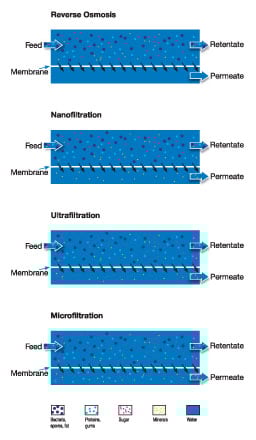
RO uses the tightest possible membrane in liquid separation. In principle, water is the only material that can permeate the membrane. All other materials (salts, sugars, etc.) will be unable to pass through.
Nanofiltration (NF)
NF is not as fine a separation process as reverse osmosis, and uses membranes that are slightly more open. Nanofiltration allows small ions to pass through while excluding larger ions and most organic components.
Ultrafiltration (UF)
UF involves using membranes in which the pores are larger and the pressure is relatively low. Salts, sugars, organic acids and smaller peptides are allowed to pass, while proteins, fats and polysaccharides are not.
Microfiltration (MF)
In MF, suspended solids, bacteria and fat globules are normally the only substances not allowed to pass through.